
Guardsman Air Duct Cleaning in Amarillo: A Homeowner’s Guide
Your Guardsman home protection plan includes a duct cleaning benefit, so it must cover a real cleaning, right? Not exactly. What most plans describe as “duct cleaning” is a subcontracted visit with no equipment standard attached to it, and that gap is where Amarillo homeowners get surprised. Before you schedule that dispatch, it helps to know what the benefit actually pays for, what it leaves out, and how the visit compares to a full-spec cleaning done with professional equipment. If you’d rather hand the whole question to someone who does this work every day, call (866) 389-4505.
What does the Guardsman duct cleaning benefit actually cover?
It covers a basic cleaning visit performed by a local vendor in the plan’s network, and the plan language rarely goes further than that. Guardsman doesn’t own a duct cleaning system and doesn’t send its own equipment. It contracts the work out. That means the quality of what shows up at your door depends entirely on which vendor accepts the job, what rig they run, and how much time they’re given for it.
That’s not a knock on the plan. Home warranty programs are built to cover mechanical failures and routine maintenance, not to underwrite a full source-removal cleaning of a whole duct system. The benefit is real. It’s just narrower than the phrase “air duct cleaning” suggests.
Here’s what a warranty cleaning benefit typically includes:
- Accessible runs only. The main trunk lines and registers the technician can reach without cutting into walls or ceilings.
- Surface-level agitation. A brush or air whip run through the reachable sections, often without a sealed negative-pressure setup on the far end.
- No documentation requirement. The plan usually doesn’t specify before-and-after photos, so proof of work is between you and the vendor.
- No repair scope. Loose joints, disconnected flex runs and crushed sections are outside the benefit and get noted, not fixed.
Read your contract’s schedule of benefits and look for the words “cleaning of accessible ductwork.” That phrase is doing a lot of work. It’s the difference between a tidy surface pass and a proper cleaning of the system.
What does “cleaning” mean in warranty language versus industry standards?
In warranty language, cleaning means the ducts were worked on. In the NADCA ACR standard, cleaning means the entire system was put under negative pressure, every component was contacted with a mechanical agitation device, and the contamination was removed from the home rather than pushed around inside it. Those aren’t the same thing, and one of them is a lot harder to do.
The core distinction is source removal. Dust, drywall particles and debris settle in the duct system and stay there until something physically lifts them and a vacuum captures them. A surface wipe or a quick brush pass loosens material without containing it. Some of it goes up the vacuum hose. Some of it redistributes through the system and finds its way back into the rooms.
What proper source removal involves
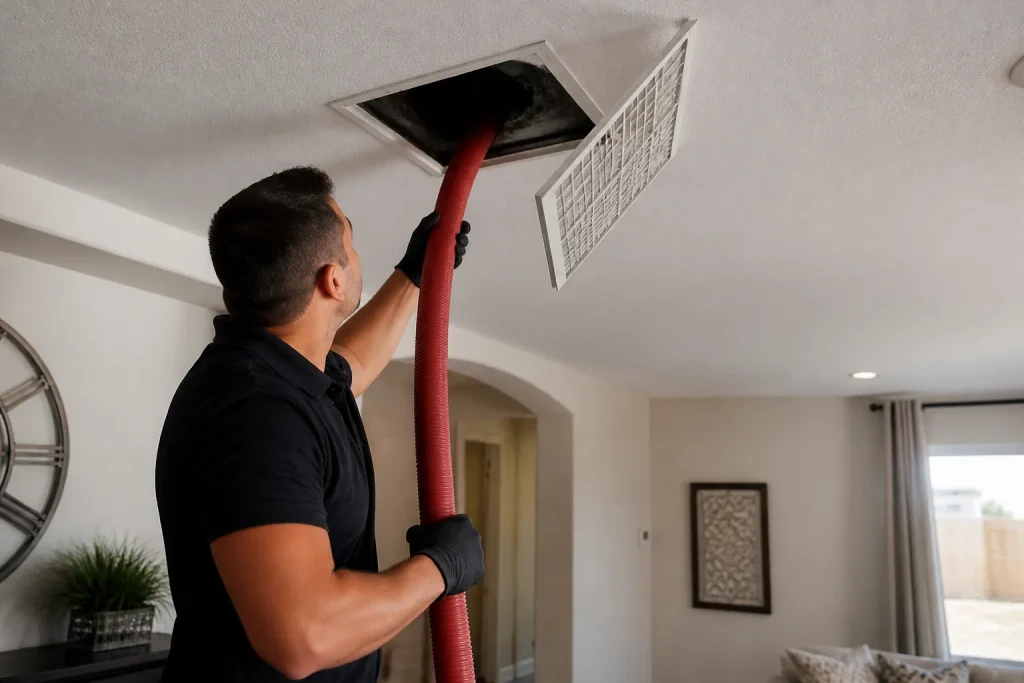
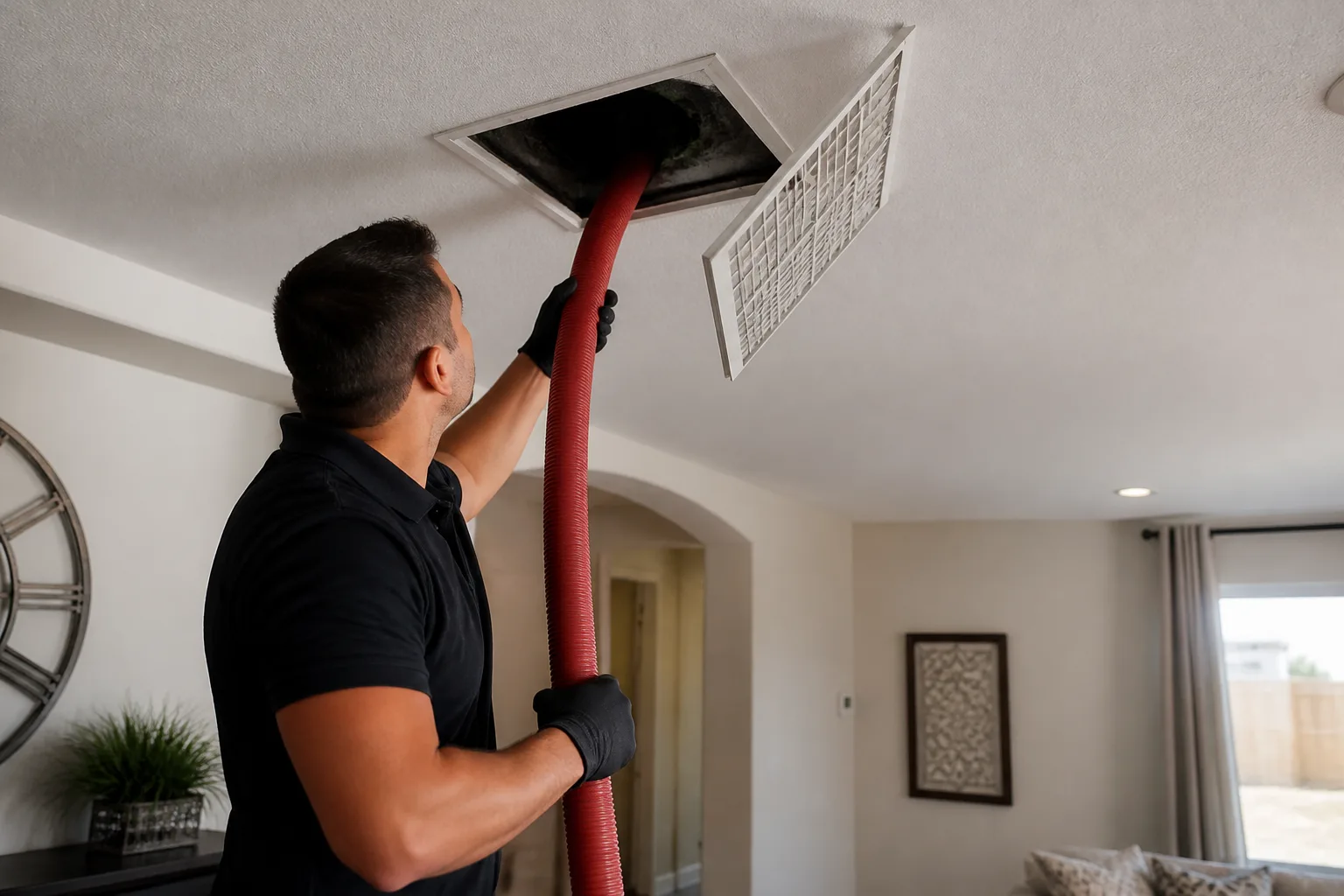
- The system is sealed at the registers and a high-powered vacuum is connected to create continuous negative pressure.
- Rotary brush and air whip tools run through each branch line and the main trunk to break material loose.
- Contamination travels toward the vacuum and out of the home, not into other rooms.
- Components get inspected, photographed and documented before and after.
In our experience, the equipment is what separates these two versions of “cleaning.” A Rotobrush or Nikro rotary system paired with a truck-mounted or high-capacity vacuum can do source removal. A shop vacuum and a hand brush cannot, no matter how long the technician stays. When you’re comparing quotes or reading a warranty benefit, the equipment question is the one that tells you which version of the job you’re getting.
What should you ask the Guardsman subcontractor before they arrive?
Ask three questions on the phone before you confirm the appointment, and ask them plainly. The answers tell you whether the visit will be a real cleaning or a quick surface pass, and a vendor who does this work well won’t hesitate on any of them.
The three questions
- What equipment will you bring? You’re listening for a rotary brush system and a high-capacity vacuum by name, not “professional equipment” in general. If the answer is vague, that’s your answer.
- How do you set up negative pressure? A proper setup seals the registers and pulls the whole system under vacuum. If the vendor describes cleaning one vent at a time with a portable unit and no containment, the work is surface-level.
- Do you document before and after? Photos of your own ducts are the simplest proof that the work happened. A vendor who documents as a matter of policy will say so immediately.
One more thing worth asking: whether they’ll note structural problems they find. Loose joints, disconnected runs and crushed flex duct show up in a lot of Amarillo homes, and a cleaning-only vendor has no path to fix them. Having air duct cleaning and repair under one roof means a problem found during cleaning gets handled, not just written down.
How does a Guardsman dispatch compare to a local specialist in the same home?
Picture the same house on the same afternoon, with two different visits. That’s the clearest way to see the gap. A Guardsman dispatch and a local specialist equipped for full-spec work are doing different jobs under the same name, and the difference shows up in the setup, the equipment and the paperwork.
- Equipment: The warranty vendor brings whatever rig it runs, which may be a portable unit. A specialist arrives with Rotobrush or Nikro rotary systems and an Abatement Technologies setup for jobs with heavier particulate, like after renovation work.
- Containment: Warranty language may not require negative pressure at all. A full-spec cleaning seals the system and holds it under vacuum for the whole job.
- Air quality products: A warranty visit ends at cleaning. A specialist who works with Honeywell and Aprilaire filtration can talk through whole-home air quality options if the ducts are contributing to a dust or allergy problem.
- Repair: A cleaning-only vendor reports problems. A full-service specialist fixes them.
- Documentation: Before-and-after photos and a clear scope are standard for a specialist, optional for a warranty dispatch.
The Guardsman brand itself is worth knowing about. Guardsman makes surface protection products for furniture, and the name is familiar from furniture protection plans. That familiarity is part of why the duct benefit feels more comprehensive than it is. It’s a warranty line item, not a cleaning methodology.
When does the Guardsman benefit make sense, and when should you pay out of pocket?
Use the benefit when the ducts are lightly dusty and you want a routine pass at no extra cost, or when you’re already having other warranty work done and want the ducts touched while the vendor is there. Keep it simple: if the plan covers a cleaning of accessible runs and your system is in decent shape, use it. It costs you nothing extra.
Pay for a full-spec cleaning instead when any of these are true:
- You’ve just finished a renovation or drywall project and there’s construction dust in the system.
- Someone in the house has allergies or asthma and you’re trying to reduce what’s circulating.
- You’ve recently bought the home and don’t know the duct history.
- The ducts haven’t been cleaned in a long stretch and the return-side dust is visible.
- You suspect a disconnected or crushed run and need inspection and repair, not just cleaning.
Those situations call for source removal with the equipment to back it up, and that’s usually outside what a warranty benefit pays for. We’ve had homeowners run the warranty visit and then book a real cleaning a few months later, which is the expensive way to do it. If you’re in Amarillo and that describes your house, it’s worth getting it done right the first time.
While you’re thinking about the duct system, don’t skip the dryer vent. It’s a separate fire-safety service with its own risk profile, and a warranty plan almost never covers it. dryer vent cleaning is worth scheduling alongside any duct work.
When to call a pro
If you’ve read your plan and the cleaning doesn’t cover what your home actually needs, call us and we’ll walk you through the scope before anyone is scheduled. Our technicians have up to 9 years of experience, and we set one flat price per system before work starts, with before-and-after photos of your own ducts so you can see what changed. We don’t just clean. We inspect and repair.
The Bottom Line
The Guardsman duct cleaning benefit is a subcontracted cleaning of accessible ductwork, and it’s worth using if your system is in reasonable shape. It is not a source-removal cleaning with negative-pressure containment, and it won’t cover structural repair. Read the plan language, ask the vendor about equipment and documentation, and decide based on what your home actually needs. Cleaner air starts inside the system, not at the filter, and the difference between a surface pass and a full cleaning shows up in the ducts themselves.
If you’re in Amarillo and want an honest read on your system, we offer free estimates. Call (866) 389-4505. We answer 24/7. Fast dispatch from 7am to 7pm, Sunday through Friday.
Frequently Asked Questions
No. Guardsman contracts the work to a local vendor in its network, and that vendor brings its own equipment and follows its own process. The plan sets the benefit, not the equipment standard or the cleaning method, so quality varies by which vendor accepts the job.
Usually not. The NADCA ACR standard calls for full source removal with the system under negative pressure and contamination captured and removed. A warranty cleaning typically covers the accessible runs only, and the plan language rarely requires negative-pressure containment or any specific equipment. Call (866) 389-4505 for an exact quote on a full-spec cleaning, estimates are free.
Rarely. Dryer vent cleaning is a separate service addressing a separate fire risk, and it typically isn’t part of a duct cleaning benefit. Ask before assuming it’s included, and treat it as its own scheduled service if it needs doing.
Before-and-after photos of your own ducts are the simplest proof. A cleaning done properly is documented, and the return-side and branch lines visible in a photo should look materially different. If a vendor doesn’t document the work, you have no way to verify it. If you want documentation as standard, call (866) 389-4505.
Written by the team at Duct Cleaning Amarillo.
Need Air Duct Cleaning Help?
Call Duct Cleaning Amarillo - licensed & insured, with free written estimates in Amarillo.
(866) 389-4505